Jury members Marres
The jury and curator team, consisting of professional artists, reviews the submissions without knowing who created the artworks. They then use their selections to design a space at Marres, where they also display their own work.
Morena Bamberger
Morena Bamberger (Roermond, the Netherlands, 1994) is a multidisciplinary artist whose work operates at the intersection of installation art, sculpture, video, painting, and scenography. Her practice is deeply rooted in a sensory, mystical visual language that feels both surreal and enchanting. She creates immersive experiences in which scent, sound, and color come together in a poetic interplay of the visible and the invisible.
A recurring theme in her oeuvre is the intertwining of the everyday with the ethereal. Bamberger regards her work as “a visual channel between worlds,” guided by intuition, the subconscious, and supernatural experiences.
Raised within the Sinti community, her cultural background forms an unspoken yet essential layer in her work. “Most people see a washed-up pebble,” she observes, “but they don’t realize they are looking at a fragment of an ancient mountain range.”

Photo: Aad Hoogendoorn
Mounir Eddib

Mounir Eddib (Genk, Belgium, 1995) is a Moroccan-Belgian painter and mixed media artist, born in Waterschei, a working-class neighborhood on the edge of decommissioned coal mines in Genk. As the grandson of a miner and the son of Amazigh (Berber) parents from the border regions of Western Sahara, his autobiographical art is inspired by issues such as migration, the rawness of industrial landscapes, and North African mythology. Eddib’s work responds to the partially hidden legacy of Limburg’s mining sites.
He depicts the bodies of exploited people of color, often as ancestral spirits haunting the land. Drawing from Amazigh, Sahrawi, and Islamic folk rituals and magical practices, he imbues his art with amulet-like qualities, particularly through the use of traditionally protective materials such as lead, tar, and indigo. Additionally, he incorporates industrial waste, such as blast-furnace slag from abandoned mine heaps, physically connecting his work to these locations.
mounireddib.com
Arash Fakhim
Arash Fakhim Esmaeilian (Iran, 1987) came to the Netherlands in 1992 with his family as a political refugee. Growing up in a working-class neighborhood, a career as an artist was not an obvious path, yet Fakhim found his place in the art world. His practice explores painting through unconventional materials and methods, stretching and questioning the boundaries of the medium. A recurring theme is the clash with imposed rules and conventions—not to reject painting, but to critically examine its history and limitations. He draws inspiration from chance discoveries, everyday environments, and the tension between personal memory and collective form. His work does not seek definitive answers but opens a space between surface and depth, absence and memory, object and echo.
Fakhim works with the awareness that the art world is often shaped by closed doors and power structures. For him, art is not a neutral space, but a field where access and visibility are continually negotiated. Behind the façade of inclusivity and refinement often lies a preference for the familiar, excluding others in the process. Fakhim does not position himself as a dissident, but as a disruptive force pointing out what remains unwelcome. Through projects such as Bar Haram and Sofreh, he creates temporary, horizontal spaces as an alternative to the exclusionary logic of institutions.

Photo: Victor Wennekes
Henri Jacobs

Henri Jacobs (Zandoerle, the Netherlands, 1957) has been living and working in Brussels since 1993.
His 40 years of artistic production have resulted in a diverse oeuvre ranging from paintings, woven tapestries, murals, brick and cobblestone mosaic commissions, and ceramics, to drawings in various techniques.
In September 2013, the book Henri Jacobs – Journal Drawings was published by Roma Publications Amsterdam. The book is a record of nine years of drawing and image collecting.
In November 2024, the book New Surface Research was released by the same publisher. It presents the culmination of ten years of paper weaving. The concept of Surface Research serves as the guiding principle in exploring two-dimensionality: the tactility and recto-verso proposition of the paper surface.
henrijacobsjournaldrawings.blogspot.com
Juul Kraijer
Juul Kraijer (Assen, the Netherlands, 1970) graduated from the Academy of Visual Arts in Rotterdam in 1994.
Since then, her drawings, sculptures, photographs, and video works have been exhibited worldwide in museums and galleries and are included in numerous museum collections, including MoMA, New York; Museum Moderner Kunst, Vienna; Museum Kunst Palast, Düsseldorf; Staatliche Museen zu Berlin; MONA, Tasmania; Fondation Louis Vuitton, Paris; and various museums in the Netherlands.
Her work has received several awards, including the Pendrecht Culture Prize, the Thérèse van Duyl-Schwartze Portrait Prize, and three LensCulture Awards (Portrait and Black & White in 2018, Critics’ Choice in 2023). In 2018, her drawings were nominated for the prestigious French Prix Guerlain du Dessin Contemporain.

Charl Landvreugd

Charl Landvreugd (Paramaribo, Suriname, 1971) is an artist, curator, and educator who serves as Head of Research & Curatorial Practice at the Stedelijk Museum in Amsterdam. He holds a PhD in Curating Contemporary Art from the Royal College of Art in London and has held various fellowships, including at BAK Utrecht, the Van Abbemuseum, and the Research Center for Material Culture. His writing has been published in leading art journals and magazines such as Open Arts Journal, Small Axe Magazine, ARC Magazine, Uprising Art, and Metropolis M. Landvreugd is a member of the Akademie van Kunsten and the author of Becoming Afro-Dutch: Hybrid Being in Black Art and Culture.
Photo: Ajamu X
Bodil Ouédraogo
Bodil Ouédraogo (Amsterdam, the Netherlands, 1995) is an artist and fashion designer whose work seeks to uncover connections between different cultural forms of self-presentation. In her practice, she explores how fixed ideas about people or objects can be set in motion by introducing alternative hierarchies and perspectives. Through a multidisciplinary approach, she weaves movement, fabrics, photography, film, dance, and sculpture into what she considers the art of dressing up.
Her practice is guided by a deep sense of connectedness. Inspired by her experiences in Burkina Faso, where she often encounters the notion that a person is never alone but always part of a larger whole, she draws connections between personal and collective histories. In her work, this forms a web of stories and identities in which forgotten or neglected elements are brought back into view. By doing so, she opens a space for a radical imagination in which all parts can coexist.
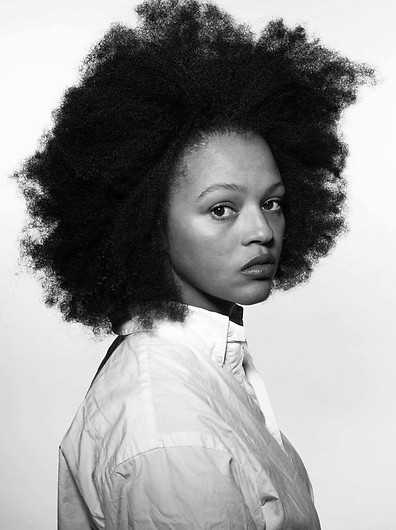
Photo: Anne Lakeman
Ilke Paddenburg

Ilke Paddenburg (1988, the Netherlands) is an award-winning actor, writer, and director. Since graduating from the Arnhem Theater School in 2011, she has worked with leading theater companies and has been a permanent member of Internationaal Theater Amsterdam (ITA) since 2019, where she has played leading roles in productions by, among others, Eline Arbo and Ivo van Hove.
In 2016 she received the Colombina for Best Female Supporting Role for her performance in Een soort Hades (Theater Utrecht). In 2022 she was nominated for the same award again, for her role in De Dokter (ITA) by Robert Icke. Paddenburg has appeared on screen in productions including Het Kamp (Gouden Kalf nomination for Best Lead Role in a Short Film) and Modern Love Amsterdam.
In recent years she has expanded her work into directing and screenwriting. Her short film debut A Day in the Life of a Female Frame premiered at the Les Arcs Film Festival 2023. Her second film, A Shot at Art, premiered at the prestigious Clermont-Ferrand International Short Film Festival and won the International Audience Award there. The film went on to screen at SXSW, Régard, Palm Springs, and others, winning the Grand Prix at multiple festivals.
Misha de Ridder
Misha de Ridder (The Netherlands, 1971) is a visual artist working with photography, video, and digital media. His contemplative images invite viewers to engage deeply with the ways we perceive and interpret the world around us.
De Ridder’s work has been widely exhibited at renowned institutions including Foam Photography Museum, the Museum of the City of New York, and the Stedelijk Museum Amsterdam. His works are part of major collections such as the Dutch Ministry of Foreign Affairs, the Museum of Fine Arts Houston, and Museum Voorlinden.

Photo: Marleen van Veen
Lydia Schouten

Photo: Annet Delfgaauw
Lydia Schouten (Leiden, the Netherlands, 1948) is widely recognized as a pioneer of performance and video art in the Netherlands. Since the 1970s, her practice has examined the position of women and the role of the artist, often through bold, layered, and confrontational imagery. With her performances and video works, she challenged taboos and incisively addressed themes of gender roles, sexuality, and power relations.
Schouten first rose to prominence with works in which she embodies multiple personae—sometimes playful, seductive, and provocative, at other times forceful and confrontational. One of her most iconic pieces, How Does It Feel to Be a Sex Object (1978), depicts her in a corset, bound by elastic cords: a striking image that conveys both vulnerability and defiance.
Her oeuvre reflects a dynamic interplay between investigative curiosity and critical reflection on societal norms, which she persistently questions and undermines.
This combative stance is balanced by a contemplative and sensitive dimension, giving her work a layered complexity that continues to resonate with broad audiences. The renewed interest from younger generations of artists and curators underscores the ongoing relevance and inspiration of her themes.
lydiaschouten.com
Koen Taselaar
Koen Taselaar (Rotterdam, Netherlands, 1986) creates a distinctive artistic universe full of visual wordplay and layered imagery. He often begins with elaborate drawings, which then expand into other media such as ceramics, screen printing, textiles, and sculpture.
In 2025, his work will be shown at CCCOD Tours, the Sainsbury Centre in Norwich, and the Asger Jorn House in Albisola.
koentaselaar.nl

Photo: Aad Hoogendoorn
Simone Trum
_LizaWolters-30_11_2022_10.jpeg)
Photo: Liza Wolters
Simone Trum (1986, the Netherlands) is a graphic designer and co-founder of Team Thursday, a design studio based in Rotterdam, which she runs together with Loes van Esch. The studio focuses on creating visual identities, books, and spatial objects, with a particular interest in typography, a curiosity for materials, and the potential performativity of objects. Always searching for patterns in their surroundings and beyond, they explore how these can be transformed into designs.
In addition to their design practice, Trum and van Esch occasionally give workshops internationally, teach Typography at ArtEZ Arnhem, and organize exhibitions. Previously, these were held in the front part of their studio, TTHQ, and from now on in their new workspace, the J.J.P. Oud Church in Rotterdam South, where TTHQ will take on a new form.